
Reflect on yourself..
Mirror
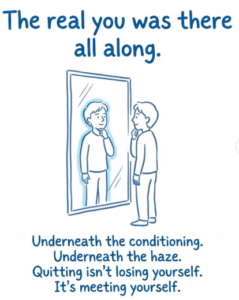
Your mirror is your self reflection. It allows to observe your thoughts and feelings, to separate yourself from the Alcohol Matrix.
Follow the below statements while watching in the mirror:
1. My Beliefs Shape My State of Mind
2. My Drinking Habits Are Learned—and I Can Learn Different Responses
3. I Strengthen My Self-Belief Beyond the Drinking Culture
4. I Understand Alcohol’s Costs—and Choose Clarity Over Fear
5. I Reflect on My Progress Over Time to Understand Cravings and Setbacks
6. I Understand the “Nothing Rule” & My Progress Is More Than a Number
1. My Beliefs Shape My State of Mind
Acknowledgement.
Alcohol offers instant gratification, but I have come to recognize how it can distract me from my direction. It moves me away from being fully present—and from the life I want to build.
Owning my direction.
I believe I have enormous potential to make a meaningful impact on the world. To act on that potential, I need clarity and direction—not something that repeatedly pulls me away from them.
Understanding the solution.
I am reshaping my limiting beliefs while using tools and support to leave the Alcohol Matrix behind. I then redirect that power of belief towards what genuinely serves me: my health, creativity, relationships, and future.
Making it happen.
My goal is not simply to stay sober through an ongoing battle of willpower. It is to build a life in which alcohol becomes less relevant.
I focus on protecting my sleep and creating a morning routine that supports clarity, energy, and creativity. Those foundations help me cultivate—and act on—the vision I want to pursue.
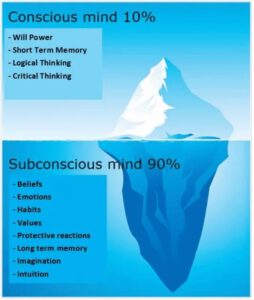
My Drinking Habits Are Learned—and I Can Learn Different Responses
Many everyday actions become automatic through repetition. I brush my teeth or follow a familiar route without consciously thinking through every step. This frees my attention for other things.
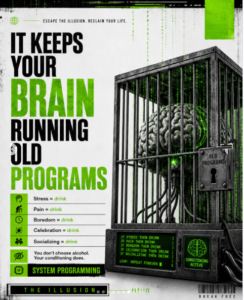
Drinking patterns can also become familiar, automatic responses. Over time, I may learn to associate alcohol with relaxing, celebrating, or connecting with others. A situation can then prompt the urge to drink before I have consciously considered what I want.
A conscious decision can begin the change, but established patterns often need more than a single decision. I can develop awareness of my triggers, question what I expect alcohol to provide, and practise responses that support my new direction.
New information can help me reconsider my beliefs. New experiences can help me discover what is possible without alcohol. Repetition helps those different responses become more familiar.
Awareness helps me notice the autopilot. Practice helps me change its direction.

I Strengthen My Self-Belief Beyond the Drinking Culture
When friends or family offer me a drink, they may associate alcohol with celebration, relaxation, socializing, or belonging. To them, it may simply be a friendly gesture. But I can also recognize how that invitation reinforces the familiar promise that alcohol makes an occasion better.
I do not have to accept that promise—or the drink—to appreciate the person offering it.
This shift can feel challenging. Drinking may once have been part of how I pleased myself, connected with others, or presented myself socially. Choosing differently can feel like a change in identity, both to me and to the people around me.
Some people may assume that not drinking means I have a drinking problem. But my decision does not need to be defined by their interpretation. For me, it means developing new priorities through a stronger belief in myself and the future I want.
I can trust my reasons without needing everyone else to share them.
The question to carry into the video below is: what belief is influencing my response?
It might be: “I am not good enough, and alcohol will help me feel accepted.” But it could also be: “Alcohol will relieve my boredom or loneliness,” or “I need it to experience fun and excitement.”
Sometimes the belief is less obvious: “I am unsure what I want, but if I follow the group, at least I will belong.”
Here, fear may be part of the pattern—the fear of rejection, standing out, or becoming isolated. Recognizing that fear helps me examine the expectation beneath it: do I really need to drink to maintain this connection?
I can question that expectation and practise a different response. I can seek belonging without abandoning my own direction.
My self-belief is not a battle against other people. It is the confidence to choose what serves me, even when they choose differently.
I Understand Alcohol’s Costs—and Choose Clarity Over Fear
I cannot make alcohol serve my future simply by telling myself that I am in control. Within the Alcohol Matrix framework, I look beyond the temporary experience and consider what follows: the “artifacts” and delayed consequences I have come to recognize in my own life.
I do not have to keep negotiating with a promise I no longer trust.
The motor-oil comparison helps me question why alcohol deserves so much attention. I would not spend my day wondering whether motor oil could improve my life. I want to bring that same clarity to what I now understand about alcohol—not turn every invitation into another exhausting debate.
That does not mean fear or cravings will disappear immediately. They may still arise, but they do not have to decide my direction. I can acknowledge them, use support when needed, and return to my reasons for changing.
I also do not need to judge what other people understand or why they continue drinking. My task is to recognize the pattern in my own life.
Alcohol can appear to offer relief while contributing to discomfort later. When that discomfort becomes another reason to drink, the familiar promise reinforces itself: this will help me feel better. Seeing that cycle helps me distinguish temporary relief from the lasting well-being I want.
For me, leaving the Matrix means questioning that promise and giving more attention to what genuinely serves my future.
I can take my health seriously without making alcohol the centre of my life.
Reshape the belief. Practise a different response. Make room for the life beyond the bubbles.
I Reflect on My Progress Over Time to Understand Cravings and Setbacks
Tracking my progress helps me notice changes in my cravings, routines, and responses—and recognize patterns if I return to drinking.
Emma L. Kinsey discusses the first three weeks of the process and highlights changes that may become more noticeable around weeks six to eight. I can use these timeframes as opportunities for reflection, rather than deadlines for my own recovery.
Learn where cravings come from—and explore ways to manage your emotions without relying on alcohol.
What Can We Learn From Alcoholics Anonymous (AA)?
Not every aspect of AA resonates with my approach. I prefer to question the beliefs surrounding alcohol without making “alcoholic” the defining part of someone’s identity. My emphasis is on strengthening self-belief and discovering what we want to move towards.
AA’s spiritual framework may not suit everyone either. Although its literature refers to God and a higher power, AA does not require belief in a particular religion. For MeRise, the focus is on developing confidence in our own direction by raising awareness to what we believe.
But we do not have to agree with every part of an approach to recognize its value. Connection, shared experience, and mutual support can be meaningful parts of recovery. AA offers a community where people can find those things.
The video below explores one aspect of AA that may help people avoid returning to drinking. The reason why MeRise highlights this video is simple: people often fall back into habits, because they forget how they got trapped by limited beliefs in the first place. Somehow they still think they need to ‘get something out of it’, while the illusion is being underestimated.
Knowledge alone is not enough to leave the Matrix behind. You need to put that understanding into practice and discover what it means in your own life.
The journey develops through experience: noticing your patterns, responding differently, and learning from your unique challenges and successes. Knowing why you want to change is a beginning. Practising that change is how you move forward.
If a relapse happens, it does not erase your progress or mean you should give up. It can provide information: what was happening, what did you expect alcohol to offer, and what support or practical changes might help next time?
A setback is not a verdict on who you are. It is a reason to reflect, adjust, and continue.
I Understand the “Nothing Rule” & My Progress Is More Than a Number
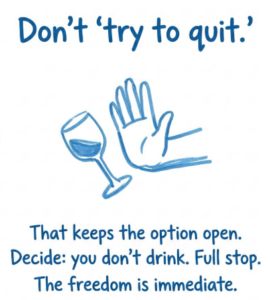
The nothing rule, explained in the “Escape” chapter, is straightforward: no alcohol today. It does not require me to settle every future occasion. It gives me a clear boundary so I can stop negotiating the first drink and focus on the life I want to build.
For me, counting alcohol-free days is not the main objective. A number alone does not tell me how I am sleeping, how I respond to stress, or whether I feel more connected and fulfilled.
Instead, I ask myself:
- Am I waking up with more clarity and energy?
- Am I finding healthier ways to respond to anxiety or discomfort?
- Am I building meaningful connections?
- Am I acting on the direction I want to follow?
Those changes give my decision its purpose.
Some people find counting days encouraging, and that is their choice. But I do not need a counter to validate mine.
If I return to drinking, a counter might reset—but my understanding, experience, and previous progress do not return to zero. I can learn from what happened and renew my boundary today.
Reshaping my beliefs helps me question what alcohol promises. Practising different responses helps me follow through, even when cravings or uncertainty arise.
The number is optional. The direction matters. No alcohol today—more attention to the life I am building.
Should I focus on alcohol free beers or wines as replacements? Of course not, I don’t need a replacement when I am in alignment with myself.