

Implications...
Implications
Implication 1: We are dealing with two different worlds, each with different objectives.
We tend to perceive a single world – what we call reality – with alcohol as just another “ingredient” within it. In this model, however, the Alcohol Matrix represents a separate world, designed to “serve only what happens inside the bubble.” Once the alcohol wears off, we return to our ordinary reality.
Our reality and the Matrix, both operates according to different rulesets with different priorities. Our reality likes to protect our health and support our long-term development. The Matrix on the other hand, proposes a shortcut to a higher sense of wellbeing (instant gratification), including side effects because it’s also a poison. So there is a conflict. In reality the liver needs to process the alcohol in order to heal/recover from Matrix events, but protecting the body’s long-term health was not the guiding priority within the Alcohol Matrix, was it?
This may sound logical, but people often underestimate the distinction between these two “worlds” and their different objectives. They may assume that what feels beneficial within the Alcohol Matrix also benefits their everyday lives. Yet the perceived benefits inside the bubble do not necessarily translate into benefits outside it.
By examining these two worlds separately, each with its own set of rules, we can better understand what happens when they repeatedly overlap. The consequences may range from mild after-effects the next day to more serious problems, including dependence or addiction.
Why separating both worlds needs more attention
Many healthcare professionals like to point out to people, mentioning their attempt to escape reality, to forget their problems, avoid discomfort, or seek relief. In that sense those experts already try to separate both worlds. The Matrix model offers a deeper interpretation: people may not experience themselves to escape reality at all. Instead, they may experience the pleasure, confidence and excitement associated with drinking as something that genuinely improves their lives. Although these effects occur within the “bubble,” their experience feels really valuable to them. The goal is therefore not to focus on escaping reality (let’s not destroy the party), but rather to explain how merging both worlds repeatedly over time (with each different rulesets), may lead to deeper (hidden) consequences.
The video below illustrates this idea in a humorous way. Is the man trying to escape reality? Not necessarily. Another interpretation is that he believes alcohol & cocaine will enrich his life, which even makes sense by the raise of dopamine, while the potential real harm remains out of sight (any addiction can take years or decades to form). It is the repeated experience over a certain amount of time, that may reinforce the underlying belief making these substances more valuable. This becomes particularly dangerous when that belief slowly shifts from “this makes life more enjoyable” to “I need this to relieve my pain, or, without it my life feels less.” At that point, substance use can become a coping mechanism, creating a cycle in which temporary relief is followed by further harm or distress, prompting more use and potentially contributing to dependency. At that point we could ask ourselves: did he actually knew how combining both worlds repeatedly could lead to something more severe over time? This is why real education matters upfront, instead of treating the mess afterwards.
Implication 2: Reinforcing associations
We are repeatedly exposed to the idea that entering the Alcohol Matrix adds value to our everyday lives. Drinking alcohol is presented as something ordinary – even though alcohol is a drug. After all, we drink it just as we drink water, right? We do not inject it, snort it, or take it as a pill. Its familiar form can make it seem less risky.
As we come to appreciate its perceived benefits, we also indirectly learn to associate alcohol with relief from discomfort: stress, loneliness, boredom, anxiety, and so on. Alcohol can begin to seem like a win-win: on the one hand, it appears to offer relaxation, pleasure, excitement, belonging, etc; on the other, it appears to relieve emotional pain.
In short, the Matrix seems to offer both pleasure and relief. This matters because these two associations can reinforce each other, strengthening the value we attach to alcohol over time. The examples below describe our beliefs to perceived benefits, where both pleasure and pain are being adressed.
“I like to celebrate.”
The perceived pleasure: “Alcohol is the cherry on top of the cake. It seems to amplify the excitement already there, making the occasion feel even more special.”
The underlying discomfort: “Without it, the celebration feels incomplete, or I find it difficult to get into the mood.”
“I like to socialise.”
The perceived pleasure: “Alcohol feels like the ultimate social glue. Connecting with others seems easier.”
The underlying discomfort: “I feel empty or lonely, even when surrounded by people. I feel shy or awkward, and alcohol seems to help me take the edge off, break the ice, and blend into the group.”
“I like to take the edge off.”
The perceived pleasure: “Alcohol seems to help me face emotionally demanding moments with confidence and a sense of control.”
The underlying discomfort: “I feel anxious about giving a wedding speech or attending a funeral. These situations bring up emotions that can be difficult to handle.”
“I like to relax.”
The perceived pleasure: “Alcohol makes me feel calm and puts me in the right mood. For a while, nothing seems to be missing. I feel at ease, and life seems fine as it is.”
The underlying discomfort: “I feel tense after a demanding day at work. There is too much information to process. I worry about paying the bills, my children need attention, and I have little time for myself. I feel exhausted.”
“I like to stay in the flow.”
The perceived pleasure: “Alcohol seems to help things flow naturally, towards familiar and comfortable outcomes.”
The underlying discomfort: “I do not know what comes next. I feel bored when there is too little stimulation and anxious when there is too much. I struggle to find a comfortable rhythm.”
“I like excitement.”
The perceived pleasure: “Alcohol makes me feel energised and excited about people and what life has to offer.”
The underlying discomfort: “I feel bored or dissatisfied. I find it difficult to enjoy other people’s company, and I miss having something to look forward to.”
“I like to fall asleep.”
The perceived pleasure: “Alcohol makes me feel drowsy. Falling asleep seems like a way to switch off and let go.”
The underlying discomfort: “I worry, and my thoughts keep me awake. I overthink and struggle to find peace.”
P.S. Feeling drowsy is not the same as getting restorative sleep; this example describes the appeal of the experience, not a benefit to sleep quality.
“I like to feel fulfilled.”
The perceived pleasure: “Alcohol makes me feel peaceful and present, as though I am content with my life.”
The underlying discomfort: “I struggle to do the things that fulfil me or move in a direction that feels meaningful. Alcohol seems to help me forget that gap for a while.”
“I like to belong.”
The perceived pleasure: “I find it easier to entertain others with stories and humour. I feel liked and accepted.”
The underlying discomfort: “I feel that I am not good enough – as though I am only a six out of ten. I struggle with low self-esteem and self-rejection.”
“I like to reconnect with myself.”
The perceived pleasure: “Alcohol seems to help me feel grounded in the present moment and more comfortable with my emotions.”
The underlying discomfort: “I need a break from the noise and demands of work. I feel hurt when the person I turn to does not understand my pain. I feel lost and want to find my way back to myself.”
Conclusion
Our beliefs about alcohol can be reinforced from two directions: the pursuit of pleasure and the relief of discomfort. These associations can strengthen each other, making alcohol seem increasingly valuable.
The relief side is easy to overlook. People may describe drinking mainly as a pleasurable experience without recognising how much of its appeal comes from easing discomfort. Within the Matrix model, this distinction matters: something that feels like an enhancement to life may also be a way of avoiding feelings that deserve attention.
Discomfort can sometimes signal a need for change, support, or care. Stress may point to an unsustainable workload; loneliness may reveal a need for meaningful connection; dissatisfaction may prompt us to reconsider a relationship, a job, or our daily habits. Listening to these feelings can help us understand what needs attention.
This does not mean that all pain is useful, that it must simply be endured, or that seeking relief is wrong. The important distinction is between temporary relief and addressing the underlying problem.
When alcohol repeatedly becomes the main way of managing discomfort, those underlying problems may remain unresolved. The temporary relief can then reinforce further drinking, while the original difficulties – and any additional harm associated with drinking – persist or worsen.
The danger is therefore not only the pursuit of pleasure. It is also the growing belief that alcohol is necessary to feel comfortable, connected, confident, or at peace. Recognising that pattern can be an important step towards addressing what is happening outside the bubble.
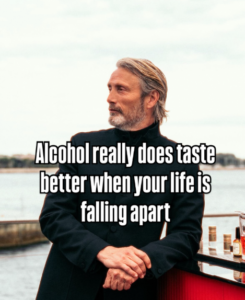
A self-reinforcing cycle
The implication goes further: alcohol can introduce discomfort of its own, while appearing to offer relief from that same discomfort. The most obvious example is a hangover the next day. Someone may be tempted to drink again, believing that another drink will take the edge off and restore a sense of pleasure. But drinking again is not a remedy for the underlying harm; it can become part of the cycle.
Other alcohol-related difficulties may be less immediately recognisable. Depending on a person’s drinking patterns and circumstances, these can range from reduced productivity at work to serious difficulties involving mood, health, and relationships. A person may not recognise alcohol’s contribution to these problems, particularly when drinking still feels like a source of enjoyment or relief.
Here lies the trap: the discomfort associated with drinking can become another reason to drink. If alcohol continues to provide perceived relief, even temporarily, that experience can reinforce the limiting belief that returning to the Matrix will make life better. What appears to be a solution may therefore be helping to sustain the problem.
This raises a chicken-and-egg question: can alcohol become problematic for people who deliberately use it to cope with discomfort, or can the consequences also develop when someone sees drinking mainly as a source of pleasure?
It is tempting to assume that problems arise only when people knowingly use alcohol as a coping mechanism. But that is an incomplete picture. Pleasure-seeking and coping are not necessarily separate categories. Someone may begin by associating alcohol with celebration, excitement, or connection, then gradually learn to associate it with relief from stress, loneliness, or other difficult feelings. The pleasure derived from having a drink can act as a catalysator, that reinforces psychological dependence to alcohol whenever pain or stress comes into play.
These associations can overlap and reinforce each other. Drinking may feel pleasurable partly because it reduces discomfort, even when the person describes their motivation simply as “having fun.” If drinking also creates further difficulties, the perceived need for relief can grow stronger.
Consider the video mentioned earlier: is the man pursuing pleasure, dealing with discomfort, or both? Outwardly, his behaviour might be interpreted as pleasure-seeking. However, appearance alone cannot tell us what he is feeling or why he is using substances. The point is not to diagnose him, but to question whether pleasure and relief can always be neatly separated.
Not everyone follows the same path, and dependence is not inevitable. The important implication is that a belief in alcohol’s pleasurable effects can coexist with – and gradually become intertwined with – a belief that it is needed to manage discomfort. Within the Matrix model, that overlap helps explain how something experienced as an enhancement to life, can become a self-reinforcing cycle of use, harm, and temporary relief. We need to keep in mind what the Matrix actually is: a temporary place we revisit for its beneficial effects by its own rulesets.
Implication 3: Anxiety
Alcohol can temporarily ease anxiety while also contributing to conditions that make anxiety worse. Within the Alcohol Matrix model, this creates a troubling feedback loop: the bubble becomes more attractive because it appears to relieve discomfort that drinking may itself have helped create.
How alcohol can contribute to the cycle of anxiety
Disrupted sleep
Alcohol may make someone feel sleepy, but sedation is not the same as restorative sleep. Research shows that drinking before bed can delay the REM cycle of sleep, and reduce the time spent in that stage, with greater disruption at higher doses. Spending longer time in bed will not solve that problem. When drinking becomes a recurring habit, it will affect the quality of sleep long term, not just the occasional poor night after a party. Sleep problems can accompany alcohol withdrawal and the heightened distress associated with dependence. Within the Matrix, however, the next drink may still appear to offer relaxation. The perceived answer remains the same, even when drinking is contributing to the problem.
Changes in calming and stimulating signals
GABA is a neurotransmitter that usually helps inhibit activity in the brain, while glutamate generally has a stimulating effect. However, alcohol increases GABA’s inhibitory effects and reduces glutamate’s stimulating effects, which can make someone feel calmer or less alert in the short term. With repeated drinking and the development of physical dependence, the brain adapts. When alcohol is reduced or removed, the altered balance can contribute to withdrawal symptoms such as anxiety, irritability, and restlessness. This is more complex than saying that the brain simply “makes less GABA.” At that point, drinking again may feel like a return to normal rather than a pursuit of pleasure. Relief can become another powerful reason to (re)join the Matrix by the belief to improve “reality again”.
Reward learning
Dopamine is not simply a “feel-good chemical.” It plays an important role in learning to associate alcohol – and the people, places, or situations connected with it – with reward. Those associations can strengthen the motivation to drink. In the addiction cycle, reduced reward activity and increased stress activity during withdrawal, can contribute to low mood and anxiety. Alcohol may then seem attractive both for its anticipated pleasure and for relief from the discomfort of being without it. These are dependence-related mechanisms, not an inevitable outcome for everyone who drinks.
Stress as a delayed consequence
Alcohol’s relationship with stress is not adequately explained by saying that cortisol always rises and remains high. A clearer point is that excessive drinking can alter stress-related brain systems, while withdrawal can heighten negative emotional states. Drinking-related difficulties at work or in relationships can create additional worry and distress. If alcohol remains the person’s main way of finding relief, those delayed consequences may become further reasons to drink.
When relief is mistaken for confidence
Consider someone who feels too shy to approach a person they are attracted to. After drinking, they may feel more relaxed, less inhibited, and more confident. They may interpret the experience as evidence that alcohol improves their social life. Within the Matrix model, this illustrates how pleasure and relief can overlap. The interaction may feel enjoyable partly because the fear of being judged has temporarily eased.
That does not mean the person will inevitably become dependent or stop developing social skills. The concern is that, if alcohol repeatedly becomes a prerequisite for socialising, the belief “I need a drink to feel confident” may become stronger. Relying on that shortcut can leave fewer opportunities to discover that connection is possible without it. Again, both the Matrix & Reality are separate entities with different rulesets. Choosing for the ‘confident benefits’ within the Matrix can become more attractive than coping with our anxieties in reality. The central implication is not that alcohol causes every anxious feeling. It is that alcohol can become both a contributor to distress and a source of temporary relief. The experience inside the bubble may still feel positive, while the difficulties outside it become harder to ignore. This is where our beliefs come into conflict, as we mistakenly belief to control the Matrix while it can actually built value as a solution to our needs.

 People seek confidence within the Matrix. But as artifacts are introduced, anxiety can increase, creating the loop.
Implication 4: The Matrix bubble leaves consequences in reality
The Alcohol Matrix describes a temporary shift in how someone experiences the world. Inside the bubble, pleasure, relief, and immediate connection may feel more important than consequences. Outside it, responsibilities, relationships, and long-term needs remain.
These are not literally two separate realities. The bubble is a metaphor for an altered experience within the same world – and its boundary is not sealed. What happens during intoxication can affect life long after the alcohol wears off.
When experiences no longer align
Someone who is sober and someone who is intoxicated may experience the same interaction differently. A joke that feels hilarious to one person may seem repetitive or uncomfortable to the other. What feels like openness or confidence from inside the bubble may come across as poor listening, overfamiliarity, or disregard for boundaries. Alcohol can affect mood, clear thinking, and coordination, helping explain why these differences can arise.
This does not mean intoxicated people are less intelligent or less worthy of respect. Nor does it mean sober and intoxicated people can never connect. It means that shared space does not always produce a shared experience.
Consider an airplane passenger enjoying a drink while the pilot is responsible for a safe flight. The passenger may be focused on relaxation and conversation; the pilot must prioritise attention, judgement, and safety. The contrast is not that they belong to incompatible worlds or cannot connect as people. It is that the passenger’s immediate experience cannot replace the responsibilities on which everyone depends.
A similar tension can arise between loved ones. One person may experience drinking as enjoyment, while another experiences their behaviour as distance, unpredictability, or a broken promise. The disagreement may involve both the effects of alcohol and different beliefs about what drinking means.
When the bubble dissolves
The central implication becomes clearest when intoxication ends: the altered state fades, but its consequences may remain. The comedy movie ‘The Hangover’ offers an exaggerated, fictional illustration of this idea. The characters must deal with the aftermath of a night they cannot fully reconstruct. It is not evidence about ordinary drinking, but it captures the contrast between an experience in the moment and the consequences that follow.
In everyday life, the aftermath may be less dramatic: a missed commitment, an argument, money spent impulsively, or a message someone regrets sending. Other consequences can be much more serious, including injuries and harm to other people. Excessive drinking increases the risk of immediate harms as well as longer-term health and social problems.
Within this model, these are the “artifacts”: consequences that remain after the experience that produced them within the Matrix. The term does not imply that every drinking occasion creates harm. It highlights that becoming sober does not automatically undo what happened while intoxicated.
Delayed consequences
Some effects are apparent the next morning. Others develop over time or become noticeable only after a pattern of drinking has been established.
Ethanol is a psychoactive, toxic substance that can cause dependence. Its risk depends on the amount consumed, the pattern of drinking, individual circumstances, and the situation. Most alcohol-related harm comes from heavy episodic or sustained heavy drinking, although some risks occur at lower levels too.
Alcohol consumption increases the risk of several cancers, including breast cancer. Excessive drinking can also contribute to liver disease, cardiovascular problems, memory difficulties, depression, and anxiety. These are risks, not a prediction that every drinker will develop every condition.
Delayed consequences can also interact with existing challenges. Imagine someone who is unhappy at work and regularly drinks to switch off. If that pattern contributes to poorer functioning, missed responsibilities, or conflict at home, life may become more difficult. Drinking can then seem even more valuable as a way of escaping the growing discomfort. Alcohol-related work, family, and financial problems are recognised harms, but this particular sequence is an illustration – not an inevitable progression.
This connects back to Implications 2 and 3: reward and temporary relief can reinforce drinking, while drinking-related difficulties can create further reasons to seek relief. The cycle is particularly relevant when heavy use and dependence develop.
What alcohol can take away
To express the costs more directly, alcohol can take away things that matter outside the bubble:
- Peace of mind: drinking can worsen anxiety, low mood, and relationship distress.
- Clarity and memory: intoxication can interfere with clear thinking, while excessive use over time can contribute to memory and learning problems.
- Physical health: heavy drinking can damage the liver and heart, weaken immune defences, and disrupt hormonal and reproductive functioning. Alcohol also increases the risk of several cancers.
- Safety: excessive drinking increases the risk of injuries and can harm people other than the person drinking.
- Connection: alcohol-related behaviour can strain relationships and make family life more difficult.
- Time and opportunity: work and financial problems can divert attention and resources from the life someone wants to build.
Not every cost arrives as a crisis. Some are quieter: a neglected commitment, a repeated argument, or a pattern that gradually crowds out other priorities. Those effects still deserve attention without portraying the person experiencing them as weak or morally deficient.
The central warning of this implication
The bubble may feel rewarding while it lasts. But its disappearance does not erase the consequences of the decisions made inside it, nor the health risks associated with drinking over time. The mistake is assuming that the Matrix rulesets will also support life in our reality. Temporary comfort can carry lasting costs. The bubble disappears (alcohol wearing off), the consequences may not.
People tend to focus on alcohol benefits and some experts call those benefits illusions (not driven by the rulesets of reality). It might be better to recognise the benefits as real in the bubbles, while artifacts and delayed consequences are left behind in our reality. Think about the concept of any hard drug such as heroin: more discomforts are introduced over time, so the Matrix becomes more valuable by Matrix benefits as it will provide more relief. This is why we should isolate The Matrix by its own rulesets.
Alcohol is a hard drug concept. Its direction matters more than its speed. The way how people may get hit over time doesn’t change the direction of the Matrix itself. Repeating poison can only steal from life.
Alcohol steals your peace: increase anxiety, panic attacks, emotional dysregulation
Alcohol steals your energy: chronic fatigue, poor sleep, insomnia, disrupted REM cycles
Alcohol steals your heart: high blood pressure, stroke risk, cardiomyopathy.
Alcohol steals your memory: brain shrinkage, dementia, cognitive decline.
Alcohol steals your strength: osteoporosis, hormonal imbalance, immune suppression.
Alcohol steals your joy: depression, irritability, high cortisol, emotional numbness.
Alcohol steals your fertility: hormonal disruption, sexual dysfunction, pregnancy complications.
Alcohol steals your glow: vitamin deficiencies, inflammation, skin damage, bloating.
Alcohol steals your health: liver disease, kidney strain, ulcers, cancer risk.
Alcohol steals your future: increased risk of suicide, chronic illness, preventable death.
Alcohol steals your spirit: increased selfishness to the Matrix, less motivation to serve others in reality.


Implication 5: Tolerance
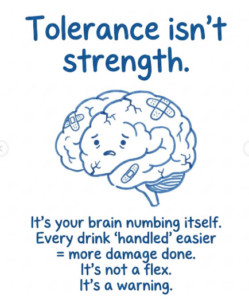
With repeated drinking, someone may find that the amount of alcohol that once produced a particular feeling no longer has the same effect. This is tolerance: a reduced response to some of alcohol’s effects after repeated exposure. It can encourage a person to drink more in pursuit of the experience they remember.
Within the Alcohol Matrix model, the bubble may seem to require more “fuel” to deliver the same experience. What once felt sufficient may begin to feel disappointing. If alcohol is strongly associated with pleasure, confidence, or relief, that disappointment can become a reason to have another drink. The implication is not that everyone inevitably increases their drinking. It is that tolerance can add pressure to a pattern already reinforced by anticipated reward and relief.
Adaptation is not protection
The brain and body can adapt to repeated alcohol exposure, changing how alcohol is processed or how someone responds to it. But adaptation should not be mistaken for immunity to harm. Feeling less intoxicated does not establish that alcohol is doing less damage.
Tolerance is also not a single shield that weakens every effect equally. A person may notice less of a desired short-term effect while still facing health risks. Drinking more to recover that familiar feeling can increase exposure to alcohol without providing corresponding protection for the liver, heart, or other organs. The crucial distinction is therefore between feeling less affected and being less harmed. They are not the same thing.
How tolerance connects with the earlier implications
Implication 2 describes how pleasure and relief can reinforce each other. Implication 3 considered how drinking can contribute to distress that then becomes another reason to drink. Implication 4 examines consequences that remain after intoxication ends.
Tolerance can add another layer: some of the expected effects become less noticeable, encouraging greater consumption. If a person responds by repeatedly increasing their intake, the risks and consequences can grow, while drinking may still seem necessary to obtain reward or relief. This is a possible reinforcing cycle, not an inevitable path for every drinker. The bubble can therefore become more demanding without becoming more beneficial to the person’s longer-term life.
Conclusion
Tolerance does not prove that the body has made alcohol safe. Nor does it mean that escalation is unavoidable or that reducing consumption cannot work.
The danger lies in responding to a weaker effect by continually increasing the dose. Chasing the same experience can expose someone to greater harm, even while they feel that they are simply maintaining what used to work.
The central implication is this: needing more alcohol to feel the same is not evidence of greater resilience. It can be a warning that the pursuit of the bubble is becoming more costly.
Safety note: If someone is physically dependent on alcohol, abruptly stopping or reducing drinking too quickly can cause dangerous withdrawal. Changes should be made with medical advice and support. A fall in tolerance should not be treated as a way to pursue stronger intoxication.
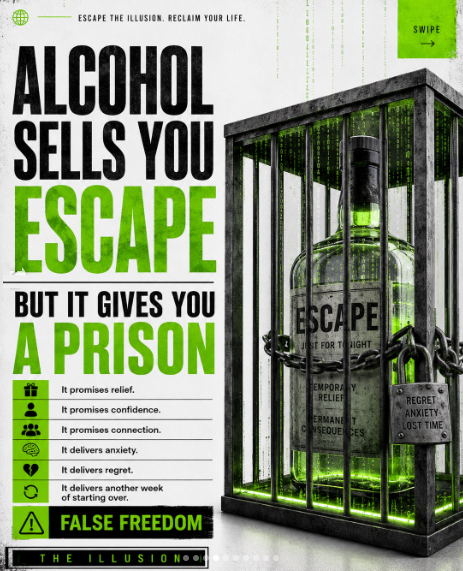
The Matrix prison
Many of the difficulties people face exist independently of alcohol. Problems at work, relationship tensions, loneliness, or uncertainty about the future may each need attention in their own right. Alcohol does not have to be the original cause of a problem to make dealing with it more difficult.
The danger arises when drinking repeatedly becomes a substitute for addressing those difficulties. Whether or not someone thinks of it as “escaping,” the temporary relief can feel like a solution. Yet feeling better for a while is not the same as resolving what is wrong.
Within the Alcohol Matrix model, that distinction explains how an apparently harmless comfort can become a prison. The experience inside the bubble may feel rewarding, while the person’s life outside it becomes increasingly organised around returning to it.
The constraints do not disappear when the alcohol wears off. Learned expectations can remain: “I need a drink to relax, to connect, or to feel confident.” If drinking also contributes to disrupted sleep, anxiety, or other difficulties, it can make the challenges that were already there harder to manage.
Someone may still move comfortably from bubble to bubble while feeling held back in everyday life. The issue is not simply the time spent drinking. It is also what may be postponed: an honest conversation, a change at work, attention to personal needs, or steps towards the future they want to build.
This sense of confinement can develop gradually. Because each return to the bubble may provide immediate relief, the wider pattern can be difficult to recognise. What feels like a freely chosen comfort can begin to feel necessary.
But the prison is a metaphor, not a life sentence. Recognising the pattern can open the way to change, with support where needed. The central question is whether alcohol is serving the life someone wants- or whether that life is increasingly being arranged around alcohol.
Nevertheless, it almost seems like there is some secret quote within the alcohol industry: “The best way to keep a prisoner from escaping, is to make sure he never knows he’s in prison!”

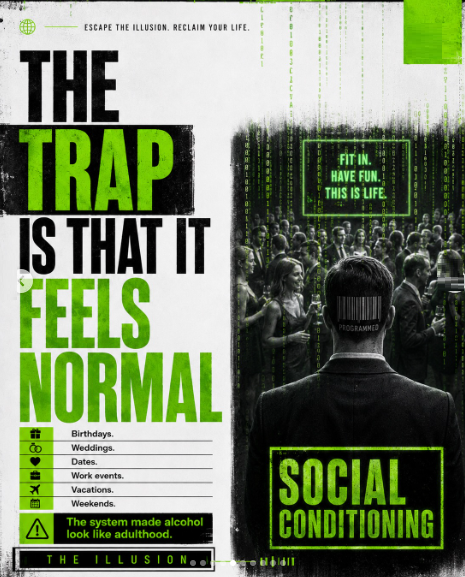
James is explaining the moment.. where people suddenly feel the need to escape the toxic relationship (prison).