Awakening...
Awakening
“Awakening” is a profound way of seeing reality beyond illusions—leading to deeper self-understanding, authenticity, and connection through questioning beliefs and embracing one’s true nature or a higher purpose.
This is the perspective that gave rise in my personal life, Me-Rise: a personal, belief-driven view of alcohol, an awakening, and the possibility of choosing a different direction.
The Starting Point
Alcohol is primarily metabolized in the liver, where it is converted into several substances. First, it is broken down into acetaldehyde, a highly toxic substance and known carcinogen. Next, acetaldehyde is broken down into acetate, a less toxic byproduct.
For me, that is the starting point: alcohol is poison, not something that can serve life. It is used in disinfectants to kill bacteria. Think about its smell, its taste, and that burning sensation. Those reactions say something important. Every child knows this, so how did we learn to see drinking it as desirable?
Why Do People Drink?
To me, alcohol needs to be understood not just as a substance, but through the belief system around it—like a religion or a hard-drug concept. Whether we are talking about alcohol, crystal meth, cocaine, heroin, or even beliefs surrounding Allah or Jesus, the comparison lies in the promises people learn to believe. External sources propose “something magical” and people engage because they expect to gain something.
These belief systems often share the same elements: the promise of more spirit, peace, confidence, happiness, or some kind of relief.
The problem, is not necessary the limited state of those beliefs. It has more to do with the direction that the religion steals over time. The comfort can easily disguise our needs beneath the surface. In my understanding, alcohol is also something people learn to medicate with, as a painkiller, also to the effects that itself creates; discomfort builds over time, and that discomfort can partly be relieved again by the same painkiller.
The beautiful truth, as I see it, is this: we cannot negotiate away the nature of the substance. This also means that we do not have to see ourselves as the problem. We can examine our beliefs—in the same way we might question a belief to any cult religion.
Eventually, al those habits are not developed to feel free. People repeat drinking more often, because they feel trapped: trapped in stress, trapped in boredom, trapped in insecurity, trapped in unprocessed emotions, trapped in a life they have not fully chosen. If we dig deeper, many people get trapped in their limited beliefs.
Of course, we do not usually describe it that way. We all “deserve” a drink to celebrate or relax after a hard day’s work. But that is exactly the point: we can build on to the belief that it helps to enrich our life. Alcohol becomes the socially approved way to disconnect from the discomfort of being human—and the pattern goes unquestioned because everyone around us seems to be doing it. That is the programming of the Alcohol Matrix. What starts as an innocent social occasion, may slowly grow into long term habits, leading to dependency or even addiction to keep satisfying our needs.
The Hard-Drug Concept
For me, this is a simple hard-drug concept: we believe the substance offers something, but it only relates to what’s happening in the bubble (the Matrix). When we get back to reality, those benefits disappear, the rules of reality reapply. What is then left behind is mostly noise, artifacts, delayed consequences ; this is up to each individual to define how this is affecting their life.
The Trap
The illusion manifest into reality by making believe that repeating alcohol improves our life. Alcohol may becoming a familiar way to regulate (more) emotions, but more harm can manifest into reality, leading to consequences. Within this framework, what interests me is how sophisticated the illusion can form at such a low natural speed and how the mind and body can reinforce that belief, even when life gets less. This process doesn’t happen as fast as heroin, but the illusion on itself is equally mind-blowing. Alcohol can conceal its costs behind a gradual pattern. Rather than one dramatic moment revealing everything, the belief effects accumulate over time, while drinking remains familiar. People may then come to depend on alcohol to maintain what feels like a reasonable life.
In my view, this makes alcohol the most dangerous drug on the planet. It steals much more effectively by using more time to condition the belief around more people. As people condition—repeat and reinforce—their beliefs over decades, drinking becomes deeply familiar and normalized. It is only by leaving the drug that its illusional power can be exposed: a conscious decision to cut back, may not easily undo years of expected emotional outcomes. Suddenly we may realize that we could easily stop eating bananas if we want to, but that we may depend on repeating a drug to regulate our deeper emotions.
People who try to cut back often rely on willpower because they feel they must resist a powerful belief anchored in their subconscious minds. From this perspective, willpower alone leaves the central question untouched: what do I still believe alcohol gives me? As long as that promise remains convincing, returning to it can remain appealing.
The Alcohol Matrix Belief System
I see the Alcohol Matrix as a framework for understanding the beliefs surrounding addictive substances, especially alcohol.
It is proposed and promoted by the alcohol industry—the so-called professional drug dealers—who use powerful marketing to sell attractively packaged poison. Drinking culture becomes its ambassador: our own friends and family may repeat the belief that the substance is beneficial and controllable “when taken in moderation, of course.”
To me, that misses the whole point. The Matrix encourages us to count the benefits inside the bubbles while overlooking what is added to life outside them. This is not about controlling a drinking event, but about our disabilities to expose how it can evolve into a reinforcing pattern over time leading to deeper consequences.
No matter the drug, no matter the amount… the question I am asking goes beyond the substance itself. This is about an illusory belief that has the power to grow & interfere furthermore with our reality. This is the exact reason for my homepage subtitle: beliefs are powerful in any direction.
My awakening was the realization that the benefits I had credited to alcohol belonged to temporary bubbles. When the bubble faded, the rest of life remained—and so did the aftereffects. Some of that discomfort could then make another bubble seem appealing, which basically builds the illusion taking place in reality itself.
That is the part I believe the marketing leaves out. It invites us to focus on pleasure, not on the possibility that the same pattern can be repeated more often while adding more discomforts over time which we want to relieve.
I Am Living Proof
I am a creative person. When I cannot express my creativity, I feel less aligned with myself. My temporary answer used to be alcohol.
What I did not realize was how drinking itself was adding to my anxiety. Over time, more tension and nervousness entered my life, and I failed to connect them with the compounding effects of the pattern.
Feeling anxious does not mean there is something wrong with you. We can all feel misaligned or experience tension sometimes. For me, the problem was that this discomfort grew while alcohol became the familiar, almost automatic answer to it.
That is how I experienced the Matrix: the pattern added to my discomfort while reinforcing my belief that it offered relief.
Whenever I left alcohol aside for a while, confidence and calmness returned. But the most noticeable change was that my creativity came alive again.
Instead of feeling trapped in tension -magnified by the alcohol itself, I began to explore possibilities and create something meaningful. My creativity had more space to express itself, simply by the reduction of anxiety (amplified by habitual drinking).
Keeping the maximum spirit and creativity long term became a no brainer for building build MeRise. I just had to ensure my quality sleep cycle.
Limited Beliefs People Hold When Leaving the Drug
- “I can’t have fun without drinking.” The reality? Fun comes from connection, laughter, and being present. Why give alcohol the credit? Having fun with a drink can become to accept a world of stupidity, as the standard for entertainment. And when life outside it feels flat, ask how much of that feeling belongs to the aftereffects of the pattern itself: boredom, loneliness, anxiety, and exhaustion.
- “I am not strong enough to quit alcohol.” The reality? You have overcome challenges before. Strength is not the absence of fear; it is showing up anyway. What feels like a lack of strength may be the conflict of still believing alcohol offers something you cannot afford to lose. Question that belief and see what changes.
- “Everyone will judge me for not drinking.” The reality? People are often more focused on themselves than on your glass—and the right people will respect your choice. Perhaps the stronger fear is “missing out” on whatever the bubble appears to provide which doesn’t even happen in reality. If you do not believe heroin serves you, would someone else’s approval make it valuable?
- “Without alcohol, life will be boring.” The reality? Life without hangovers gives you room for clarity, energy, and freedom. That is anything but boring. In my experience, alcohol takes away the sleep, spirit, and energy that make life engaging in the first place.
The Price Over Time
Eventually, the price becomes visible—and, to me, it goes much deeper than health or money.
It does not only affects the quality of our lives, but also the people around us. There is also the cost to dignity and integrity: when we repeatedly act against what we know we want, we can feel as though we are leaving ourselves behind by degrees. This is why I see sobriety as a journey back to ourselves. It forces us to criticize the reinforcing belief of the substance itself, while also exposing the initial and underlying discomforts that may have played a role in our drinking career.
The cost I want to highlight to is the lost potential. When people feel misaligned with who they are in certain environments, they get also less able to use their potential in serving others. Alcohol doesn’t solve that problem. It camouflages as a distraction, while making it worse by the characteristics of the substance. Reshaping the belief, finding alignment – and changing the environment can all lead to a strong flow in opposite direction.
For instance, I use to have a few drinks to wind off from a working day, mostly to cope with the noise. But what was actually brought into reality? I would never have the spirit to wake up at five in the morning to build MeRise. Which option serves me more: alcohol to cope while stress while disrupting my quality sleeps? Or vision by self-belief that makes me easily go out of bed to build something? Both alcohol & vision still feels like getting benefits (such as peace, freedom and excitement), but the difference is about ‘temporary’ versus ‘long term’: vision has a constant alignment to a direction.
Specifying The Why
Why would I keep negotiating with a limited belief that steals? I can still drink if I want to, but it makes sense not wanting to drink?
Why would I resist drinking with willpower? Alcohol culture, cravings, unconscious programming, they are all artifact from the Matrix.
Why would I like an illusion holding me back? The truth remains the same, I can’t unsee what I see.
Everyone can question the belief system they have learned to trust – aside from investigating an other puzzle piece that supports sobriety.
Reshaping my beliefs became the logical way to let go. My profound realization was that life without alcohol wasn’t becoming less—it was becoming more.
I tried to defend my old beliefs many times, but the truth always spoke louder: moderation reinforced those beliefs, pulling me back into the same cycle of habits.
It’s truly remarkable how powerfully the Matrix operates. This is the most sophisticated illusion I have ever seen. It’s also amazing to see how the illusion loses its grip when you simply leave belief out of the equation.
The best part? Nature always responds. It gives us feedback on the effects of poison through short-term symptoms and delayed consequences. It also gives feedback when sleep improves: more spirit and energy to invest in relationships, career, health, and a sense of purpose.
Exactly the things alcohol used to promise as part of its perfect lie.
A Society Built Around Drinking
Alcohol does not concern only people described as addicts or “problem drinkers.” It is woven into society, forming a drinking culture that I see as an “Alcohol Religion.”
Of course, we tell ourselves that we are different. We are always in control. But feeling in control is not the same as examining the belief that keeps us returning. Why should our own pattern be beyond questioning?
Denial can protect the familiar promise. Continued consumption supports an enormous industry, while people move from bubble to bubble through what feels like free choice—in moderation, of course.
My interpretation of the Matrix reveals another side: the discomfort beneath the pattern, and the belief that the next drink will help. That is why honesty about our relationship with alcohol matters before we can change it.
Alcohol as a Direction Killer
To me, alcohol is also a direction killer. It steals from tomorrow, and through repetition it steals from the future. For people who feel happy now, that may not seem like a problem. But what does it mean in terms of growth?
Think of a person deeply committed to their craft: an athlete, an artist, an entrepreneur, or anyone working towards something that matters. Their direction gives them a reason to protect the energy and attention that support it. Why trade away sleep or clarity for an experience that pulls them away from their purpose?
That is the contrast I want to make: not success versus failure, but vision versus distraction.
The question remains personal: what does drinking do to my direction? Does it support the life I am building, or make it harder to bring that life into reality?
For me, alcohol became a thief of progress or even worse: a stagnation of flow. Feeling stuck and trapped, by something I didn’t even knew it was holding me back. And yet we are encouraged to believe that repeating the same pattern for decades can remain a good thing… “without consequences.” That’s the whole point, it keeps everyone comfortable through distractions. Repeat the process long enough and you will miss direction and growth.
The MeRise awakening began when I stopped asking how to keep alcohol in my life—and started asking what I could bring into life without it.
The video below is an awakening on a much deeper level. As the introduction is a bit long, it starts around the 8 minutes.
The alcohol industry wants to sell benefits in temporary bubbles. They don’t serve anyone, life in reality operates by its own rulesets.
The key is to understand the delayed consequences being formed into our life.
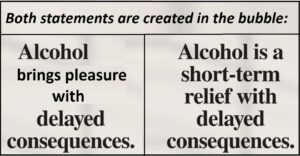
What starts as repeating pleasure may lead to delayed consequences. We underestimate how discomforts are added and equally being addressed, playing its role long term towards relief.
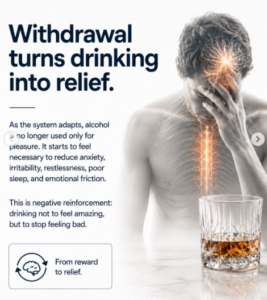
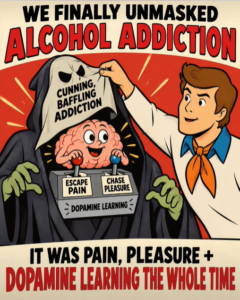
A great way to expose delayed consequences is by focussing on the opposite direction when people quit alcohol:
24-72 hours. Your body detoxes. Alcohol leaves your system, blood sugar & hydration rebalance and your nervous system resets. Cravings & discomfort peak as your body adjust.
1 week. Sleep & mood improves. REM cycles stabilize, you wake up more rested, anxiety eases and brain chemistry begins to rebalance.
2 weeks. Self-trust & self-respect builds up. You are rebuild self-trust (you have broken promises before). As you follow through, self-respect starts to return.
Your sleep transforms. The first week may be rough. but soon you’ll sleep deeper than you have in years.
3 weeks. Visible changes. Your liver starts repairing, hydration balances (skin looks brighter) and digestion improves as gut inflammation eases.
Your cravings loose power. The voice that used to control you gets quieter, you start getting stronger.
1 month. Your energy skyrockets. As you sleep stabilizes, your morning stop feeling heavy and you start feeling momentum (flow).
1-2 months. Mental clarity returns. Your mind sharpens. Brain fog lifts, focus, calmness and motivation improve and anxiety decreases as your nervous system balances.
You believe in yourself again. Each sober day is proof that you can keep your word. Alcohol becomes irrelevant. You become extremely confident, knowing that you were never the problem to begin with. Moderating alcohol was just a lie. Not engaging with any hard drug proves how you control everything.
You face the real choice now: go back to what held you back, or keep becoming who you are meant to be.
3 months+. Deeper healing. Risk of alcohol-related conditions drops, your immune system strengthens.
Below video explains the zillion consequences being repaired (healed).
Let’s define the stages of drinking to see how people meet those consequences:
The occasional drinker
They don’t have an urge to drink, but they have a few drinks by the environmental circumstances (for instance a birthday party). Alcohol creates a mild shift in their minds. They feel a little bit more relaxed. A little more social. A little more loose. Their experience stays within a manageable range. Even when they slip, they know they shouldn’t drive a car. They recover the next day and move on.
The weekly or daily drinker
For some people, drinking on a weekly or daily basis becomes an automatic habit rather than a conscious choice. They may argue otherwise: of course they are in control—they don’t see any obvious consequences.
So what happens when they try a “30 days without alcohol” challenge? It’s easy to say, “I could do that,” without actually doing it. But when they try, they may find themselves repeatedly weighing up whether to drink. Those internal negotiations can reveal how much space alcohol already occupies in their minds and routines.
What they may not recognize is a growing reliance on alcohol, reinforced by the belief that nothing is wrong. They don’t see the smaller effects as consequences yet because they don’t seem serious enough. Their sleep may be poorer, for example, but they can still function well enough at work.
This is how the pattern can remain unnoticed. People normalize minor consequences as if they don’t exist, while their cumulative impact remains hidden in plain sight.
The drinker facing the consequences
Something feels off. An internal or external voice tells them they should cut back on alcohol. They try to drink less, but moderation doesn’t seem to work. They feel conflicted because part of them doesn’t even want to change the habit. Alcohol feels like a friend.
When they do try to change, cravings, triggers, and the fear of missing out can make it difficult to follow through.
For them, alcohol seems to have a stronger impact than it does on some other drinkers. It offers instant relief, instant confidence, instant escape—what feels like instant emotional freedom. Rather than mild pleasure, they experience something more intense: the highs feel higher, and the relief from emotional pain feels stronger.
They begin to realize that two people can drink the same amount and have very different experiences. One person might feel a light buzz, while another feels a powerful shift in their entire emotional state.
But what goes up fast can come down hard. As the effects wear off, they may experience anxiety, regret, low mood, irritability, shame, emotional emptiness, or an intense preoccupation with drinking again. This crash can feel overwhelming, making alcohol seem like the quickest way to find relief once more.
Not every drinker experiences this cycle, and those who don’t may struggle to understand what it feels like to face these consequences.
– Alcohol brings relief.
– The relief fades.
– The crash can feel unbearable.
– Because alcohol is readily available, relatively inexpensive, and quick to provide temporary relief, they reach for it again.
Their struggle to change is not simply a matter of willpower, or of being good, bad, or weak. Their brain and nervous system may be caught in a cycle of seeking relief from pain and pursuing pleasure. Over time, the brain learns to associate alcohol with relief, making it feel necessary. The resulting cravings are not a moral failure.
Breaking this cycle often takes more than a conscious decision, and moderation may not work for them. The cycle itself reinforces the belief that alcohol is the solution—even as it creates more problems.
As the consequences continue to build, the need for change becomes harder to ignore. They may reach out for help, or they may hold back, believing that they themselves are the problem.
But one truth remains: the relief is temporary, while the consequences can last far longer—regardless of how they explain or justify their drinking.
Here are the more severe consequences (credits: James Wick)
Why would we deny the consequences to exist? Are those bubbles worth it? Reality likes the truth, so benefit from it.
The Delayed Consequences of Poor Sleep
Alcohol can suppress REM sleep and disrupt sleep later in the night. You may spend hours in bed yet wake up foggy, irritable, and already feeling behind before the day begins.
The fuel of the Matrix is ethanol, which your body must break down and eliminate. But clearing alcohol is not the same as recovering from disrupted sleep. When drinking repeatedly interferes with rest, feeling drained can become so familiar that you mistake it for your normal state.
Within the Matrix, the next bubble may arrive before you have regained your balance. Another drink promises relaxation or relief, making it easier to overlook the discomfort the previous bubble helped create.
The bubble offers temporary comfort, while the next day carries the cost.
The Delayed Consequences of Slower Recovery With Age
As we get older, recovering from drinking may take longer than it once did. What felt like a manageable hangover in your twenties can become a more noticeable disruption later in life. The cost is not always a headache. It can be lost focus, reduced clarity, irritability, or a lingering sense that you are not quite yourself.
Those consequences can become so familiar that people stop recognizing them as consequences. They normalize them as part of life—or simply part of getting older. From the outside, they may appear to function well at work and in their relationships, while internally they feel less settled and more easily overwhelmed by everyday tension.
Within the Matrix, that discomfort can become another reason to seek relief. The bubble receives credit for making things feel easier, while its possible contribution to the next difficult day goes unnoticed.
Consider the role alcohol may play in family conflict. An argument can seem to be entirely about someone’s personality, a stressful situation, or an old grievance. But what happens when poor sleep, irritability, and impaired judgment are also part of the picture?
Exploring past trauma can be valuable, but so can examining what is happening now. Before treating every emotional struggle as something deep within the person, ask whether alcohol is adding fuel to the fire.
Leaving alcohol aside will not erase every conflict. But it can create an opportunity to see which tensions remain—and which were being amplified by the pattern itself.
The Indirect Consequence to Coke addiction. Alcohol Can Be a Catalyst and Trigger that keeps the Door Wide Open
For some people, drinking is the first step towards using cocaine. Alcohol lowers inhibitions and impairs judgment, making it easier to cross a boundary they intended to maintain.
The combination also creates an additional danger: when cocaine and alcohol are used together, the liver produces cocaethylene, a toxic substance associated with increased cardiovascular risks, including potentially fatal complications. Combining the substances can also damage the liver.
Within the Alcohol Matrix, the consequences can therefore extend beyond the first bubble. What begins as “just a few drinks” may become the setting for further substance use and risks that were never part of the original plan.
If drinking repeatedly triggers cocaine use, addressing alcohol belongs at the centre of the conversation—not as a guaranteed cure, but as an important part of breaking the pattern. Cocaine dependence may also require dedicated treatment and support.
Do not examine only the substance that comes next. Examine what keeps opening the door to it.
This video explains alcohol being more devastating than cocaine.
The delayed consequence of Compulsive Thoughts.
The Delayed Consequence: Anxiety
Regular drinking can contribute to anxiety and, for some people, dependence. When someone tries to change the pattern, fear may become more noticeable: Will life feel less enjoyable? How will I cope? Should I return to the familiar belief, or give a different way of living a chance?
Within the Alcohol Matrix, this conflict invites us to examine what we believe we are losing. The phrase “False Evidence Appearing Real” can be a useful prompt—not because every fear is false, but because an expected loss can feel certain before we have tested that expectation.
The anxiety itself is real. What deserves questioning is the conclusion that alcohol is necessary to relieve it. If drinking contributes to the discomfort, returning to the bubble may reinforce the very pattern we want to escape.
Seeing the pattern more clearly creates an opportunity: perhaps leaving alcohol behind is not losing our source of comfort, but making room for a steadier kind of well-being.
That change is not always immediate. Anxiety may initially increase during withdrawal, and people with physical dependence may need medical guidance to stop safely.
The delayed consequence of giving up your ‘authentical self’.
The Delayed Consequence of Negotiation & Deniability. Video: Charlie Sheen
The Delayed Consequence of Waking up. Video: Charlie Sheen

The Golden Cage
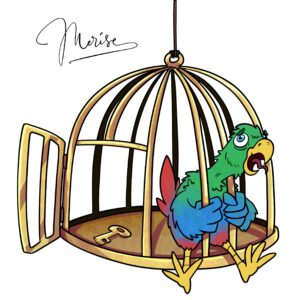 You recognize the parrot, somehow delusional by a distorted reality.
Affected by our drinking culture who still believe to perceive “benefits”.
Your beliefs have simply been conditioned over time.
But now you suddenly understand the mistake being made.
People believe in alcohol to “improve well-being at low cost the next day”.
But somehow, over enough time, people suddenly start toget stucked inside this golden cage.
People suffer mental health, lack time, energy, confidence, self-belief, spirit, freedom… feeling lost by their lack in direction.
This cage was never built around you, it was built slowly within you. It is made of illusional fears and the lies being told how you ‘should be’.
If you would drop the fear and the ‘should be’, the cage would suddenly disappear.
The cage door represents your way out; your vision. It’s the direction you need to fly and evolve to, to find flow.
The door has even a key, being your purpose! Grab it & fly away!
Now spread you wings to fly in the direction of what you believe will serve you; cultivate your own vision by your self-beliefs.
Leave the other parrots behind; let them believe that flying must be some kind of “disease” (like you are having some kind of “drinking problem” for leaving the illusional cage?)
Let them, they are ones who keep conditioning the belief. Science is on your side with the WHO (world wide health organization): no amount of alcohol is safe. It’s a scam!
Finally, as you get to understand every detail on how the cage was built, but you are ‘not out of the cage yet’. Because knowing and flying away.. are two different things.
You can still live inside the cage, knowing why you are in prison.
So the question is not even about “can you see it?”. It holds something much deeper: what role keep you playing that keeps the cage standing?
You see, the trap remains the same: the cage is your comfort zone while representing a prison. Do you hear how weird that sounds?
It’s contradictive. The cage feels safe.. but do you want to stay in the cage because the outside is too scary for you?
How about this: do you like the cage being promoted by other drug users?
This is about the role YOU stop playing. Do not only change your view on the alcohol religion… start living your own beliefs!
Relapse as many time as you need, but don’t run away from the truth. Your beliefs is your doorway to any success!
The truth is everywhere and noticed by the experts, such as Annie Grace (author of the naked mind)
Learning the truth about alcohol was so hard for me. Because once I knew, I couldn’t un-know. Fallacy after fallacy crumbled until I was standing in the wreckage of my own justifications. I thought I drank for fun. For stress relief. Because it made me more social, more confident, more me. But every reason I had was built on a lie. And the more I researched, the more I realized those lies weren’t just about alcohol, they were about myself. My worth. My needs. My fears.

Everyone gets another awakening to the same truth. Video credit: Leon Sylvestre.
How about freedom?
People Are Not Their Dependence
Struggling with alcohol does not mean there is something fundamentally wrong with you. Dependence can be a real, treatable health condition without becoming your identity—or a prediction that you will struggle forever.
Some people describe leaving alcohol behind with a surprising sense of peace. Within the Matrix framework, that experience invites an important question: what changes when alcohol no longer feels like something valuable you are being forced to give up?
When its promise becomes less convincing, leaving can feel more like freedom than deprivation. But if someone continues to struggle, that does not mean they have failed to understand the Matrix. Learned expectations, habits, physical effects, and personal circumstances can all play a part.
Think of someone who has stopped smoking and no longer wants a cigarette. They do not necessarily experience themselves as fighting tobacco every day. The same possibility deserves recognition around alcohol: a person can build a life in which drinking no longer occupies the same mental space.
That does not mean every consequence disappears immediately or that recovery disproves the existence of a condition. It means that recovery is possible, and a diagnosis does not have to define the whole person.
The MeRise message is to look beyond the individual. Examine the substance, the marketing, and the drinking culture that taught us to associate it with pleasure, relief, and belonging. Questioning those influences can help us understand the pattern without turning it into a judgment of someone’s character.
You are not defective. Your relationship with alcohol can change, and you deserve support—not shame—as you change it.
Do You Need Coaching?
The Alcohol Matrix asks you to examine a belief system—not treat yourself as defective. You are not the system; you are someone who has learned to believe its promises. So what would you want a coach or therapist to help you understand?
The aim should not be to make alcohol the centre of your identity or keep you endlessly focused on resisting it. It should be to examine what you expect from drinking, recognize the costs, and build a life beyond the pattern.
If alcohol no longer seems valuable to you, declining it may begin to feel less like a battle. Why keep defending a relationship you no longer want? Within the Matrix framework, that shift in understanding matters: letting go becomes an opportunity rather than a punishment.
But understanding does not always remove every craving, habit, or difficulty. Some people make changes without coaching; others benefit from professional care, practical guidance, or a supportive community. Needing help does not mean you have failed to see through the promise.
Be selective about the support you choose. Ask whether it strengthens your independence, respects your goals, and helps you move forward. A paid service is not automatically exploitative, but neither should you assume you need it simply because someone sells it convincingly.
You do not have to spend the rest of your life organizing yourself around alcohol. Give attention to what you want to regain: energy, clarity, meaningful relationships, and a vision that makes life outside the bubbles worth investing in.
The question is not “Must I have a coach?” It is “What understanding—and what support, if any—will help me build the life I want?”
Merise does not propose an “Anti-Religion”
I personally do not believe in God, but I respect other people’s choice to attend church. I would not walk into a church to challenge their beliefs. First, what would I hope to achieve? Second, people are free to believe differently from me.
When I believe a system is causing harm, however, it can be tempting to expose what I see as its misleading promise. That is how I feel about the Alcohol Matrix: the expectations surrounding alcohol can make leaving it feel frightening, even when the pattern no longer serves someone.
But conviction does not make confrontation useful. I could enter an AA meeting and present my interpretation of fear and belief, yet that would turn someone else’s search for support into a debate they had not asked for. My aim is not to undermine their recovery or insist that they adopt my framework.
I believe a better approach is to educate through opportunity. Instead of beginning with “You have a problem,” begin with “What could become possible?” The information may be similar, but the invitation is different: curiosity, growth, clarity, and a more fulfilling life.
MeRise does not need to wait until people are in crisis. It can speak to anyone who wants to examine their habits and explore a different direction—including people who are already struggling.
Not everyone will be ready for that conversation, and readiness can change. I do not need to force it. I can respect someone’s choice while directing my time and energy towards people who welcome the discussion.

Challenging the Experts
Question every explanation—including MeRise. The aim is to develop an understanding you can examine for yourself.
MeRise took that same approach by questioning other experts.
The Evil Clown Metaphor by Graic Beck
Craig Beck’s has a great approach what he names as ‘Escaping to the Evil Clown’. In his description of the book, Beck explains that you are not your addiction and are not weak-willed or broken. He pictures addiction as an Evil Clown inside your head, whispering encouragement as though it were your best friend. The smile is painted on; beneath it is something that can work against you.
The metaphor creates separation between the person and the addiction: you can notice the invitation without treating it as your identity. While this is true, Matrix raised additional questions:
What Gives the Clown Its Voice?
When does the clown start whispering—and why?
What makes its promise convincing?
If we are not the addiction, why does the clown live in our heads?
Where did we learn to associate alcohol with relief, excitement, or connection?
And why can those expectations remain powerful after the drink has worn off?
These questions matter more than imagining a clown in your head working against you.
There is no creature to locate or remove. The metaphor represents something we experience: an invitation that can feel persuasive even when we have decided not to follow it.
What the Matrix Adds
The Alcohol Matrix separates two parts of the pattern: the temporary experience inside the bubble and the belief carried back into sober life.
Inside the bubble, alcohol may change how the evening feels. Discomfort seems quieter, conversation easier, or excitement more immediate. That experience can become evidence for a broader belief: “Alcohol improves my life.”
Within the metaphor, this is where the clown gets its material. It learns which promises seem convincing—not because it is a real being, but because the experience supplies memories and expectations we may return to.
Then the bubble dissolves.
What happens to the promise? It does not necessarily disappear with the drink. Later, when we are sober, an invitation may return: “Remember how good that felt? Wouldn’t another drink make this moment better?”
The experience has ended, but the expectation remains.
That is the deeper illusion MeRise wants to highlight. The question is not only what happens while we drink. It is how we interpret that experience afterwards—and what that interpretation encourages us to do next.
The Echo After the Bubble
Think of the clown’s whisper as an echo of previous experiences, like an afterglow that remains after the original event. The remembered pleasure can seem close and vivid, while the costs receive less attention.
But an echo is not a guarantee. Remembering relief does not establish that another drink will improve the whole situation. Nor does anticipating pleasure tell us what the pattern will leave behind tomorrow.
The craving itself is real. Calling the clown imaginary does not make the emotional or physical experience disappear. This metaphor describes one way learned expectations can reinforce the pattern; it is not a complete explanation of dependence.
The distinction is between a genuinely felt urge and the promise attached to it. We can acknowledge the urge while questioning what it tells us we need.
If alcohol has also contributed to discomfort outside the bubble, its remembered relief may become even more appealing. The promise receives credit for easing a difficult moment, while its part in creating that difficulty may go unnoticed.
What Are We Expecting to Create?
Much of life involves anticipation. We imagine a result, choose an action, and hope it will bring us closer to that result.
With alcohol, the same process can become misleading. We picture an enjoyable bubble and treat it as a picture of a better reality. Yet the temporary experience and the life that follows are not the same thing.
This is why MeRise asks us to examine the full sequence: what we expect, what we experience, what remains afterwards, and what we choose to repeat.
Beck’s clown gives the persuasive invitation a character. The Matrix gives us another way to trace the promise: from an experience, to a memory, to an expectation, and back to another drinking occasion.
Neither image needs to be taken literally to make that pattern worth examining.
The bubble ends. The promise can remain. The deeper question is whether we keep mistaking that promise for proof that alcohol serves our lives.
Turn the Question Around
Here is another way to examine the pattern: would the Evil Clown encourage you to stop after your first drink? Would it remind you of tomorrow’s priorities or help you question whether another drink serves you?
Within this metaphor, its invitation points the other way: stay a little longer, have another, return to the experience.
The bubble is where that promise gets fed. Pleasure or relief can make the experience feel convincing: “This is a wonderful place to be.” When the bubble dissolves, however, the expectation does not necessarily disappear with it.
Later, you may look in the mirror, completely sober, and still feel drawn towards another drink. 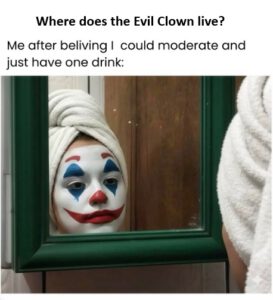 That is the confusing part: the experience belongs to an earlier bubble, but its promise is influencing a decision in the present.
The clown’s “echo” represents that remembered expectation—not a creature living somewhere inside you, nor proof that another drink will give you what you need. The craving is real; the conclusion attached to it deserves examination.
If the urge becomes a source of fear—“Why do I still want this? Will I ever feel comfortable without it?”—alcohol may appear to offer relief again. The pattern can reinforce itself.
The deeper trick is not simply making the bubble feel appealing. It is allowing the remembered appeal to stand as evidence that returning will improve your life.
Recognize the Clown’s Call
You are not defined by dependence or addiction. You can examine the belief that alcohol benefits you without treating that belief as who you are.
There is no literal Evil Clown living in your head. Within the Matrix metaphor, the clown represents a promise formed through experiences inside the bubbles—a promise that can return as a persuasive thought when you are sober.
Inspired by Craig Beck’s metaphor, imagine an alarm whenever that familiar invitation appears:
DING! DING! DING!
Recognize the call from the “wonderful Matrix place.” Imagine the clown finally explaining its promise honestly:
“I may appear as a thought in your everyday life, but I am an echo—a reminder of how appealing the bubble once felt”.
“I am here to tell you that the experience will be familiar, comforting, and wonderful”.
“I love to negotiate: just one drink, just this occasion, just a little escape. Come back in—you know me!”
“But this time, let me admit what my promise leaves out. I offer an experience inside the bubble. I make no guarantees about the life you return to afterwards”.
“Your safety, money, time, energy, sleep, mood, and future outside the bubble are not part of my sales pitch. I invite you to remember the feeling inside—not to count the cost”.
“The only place I actually care about is where I live; inside the bubble.”
Conclusion
The evil clown lives in the bubble, not in your head. Its echo is the illusion taking place in your reality: the false promise of serving your life.
The urge may be real, but its promise is not an instruction—and familiarity is not proof that it serves you.
You do not have to fight an imaginary character. You can recognize the invitation, question what it leaves out, and choose a response that supports your life beyond it.
Hear the call. Notice the promise. Remember the whole picture.